Talent

Talent aligned to business needs

Collaborative regional solutions support talent retention, alignment, and growth

Northeast Ohio is retaining more college graduates and growing the 25-34 age group. And significant efforts are underway to attract and connect talent to in-demand careers, today and in the future.

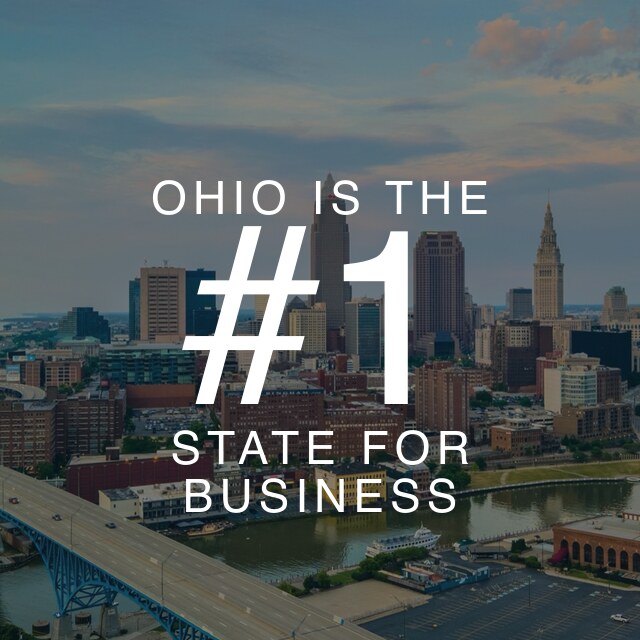
Ohio is the #1 state for business, set over the Cleveland skyline

New on the site

Ohio is the #1 state for business

CNBC ranked Ohio first among all 50 states in 2025. See how the state has placed each year, charted alongside the rest of the competitiveness indicators.

What this tells you

The data, shaped around your work.

Current Population

3.7 Million People

There are nearly 3.7 million people throughout the 14 counties in Northeast Ohio.

Degree Holders

1.1 Million Degree Holders

Over 1 million Northeast Ohioans hold a college degree.

College-Educated Population

Degree Growth Forecasted

The region’s college-educated population is projected to grow 8% by 2030.

Workforce ecosystem

Data is only part of the story

Together, businesses, higher education, and nonprofit partners are creating more pathways to career opportunity—expanding the talent pipeline and helping Northeast Ohio attract, develop, and retain early-career talent.  

See the partners, the pathways, and the hidden talent the standard labor data leaves out.

Working alongside Team NEO and our local partners to anchor Sherwin-Williams and its new headquarters and R&D center in Northeast Ohio created new opportunities to keep more Ohio students in the state and help them build long-term careers here.

J.P. Nauseef, JobsOhio President and CEO

Metric 01

Skills-to-Jobs Alignment

The alignment between credentials produced in the region and the jobs employers are trying to fill.

Methodology & definitions

Credential to Market Demand Ratio Compares the number of students graduating from programs for in-demand industries to the number of available job opportunities. A lower ratio (downward trend) indicates a gap between the supply of prepared graduates and the demand for that industry.

Source — Lightcast; Team NEO Calculations

Calculated as degree completions divided by unique job postings. Programs and occupations by sector can be provided on request.

30% IT completions  IT-related completions grew 30% from 2018 to 2024.
11% → 6% Credential-to-market ratio Healthcare supply has fallen further behind demand since 2018. We have rebounded from a low point in 2022.
2× Healthcare postings growth Openings in healthcare more than doubled between 2018 and 2024.

Talent Is Growing. Opportunity Is Growing Faster.

Northeast Ohio's workforce is large, skilled, and becoming more educated every year. As demand accelerates in healthcare, manufacturing, and technology, the region has an opportunity to produce more credentials aligned with these high-demand careers. Tracking the credential-to-market ratio helps measure how well education and training are keeping pace with employer demand, and where targeted investments can strengthen the talent pipeline.

A widening gap between openings and graduates

Switch industries to compare healthcare, manufacturing, and IT, side by side. The dashed line is Cincinnati, providing a useful metric for showing whether the pattern is regional or statewide.

Northeast Ohio · 2018–2024

Regional initiative

Stark Career Connect

Stark Career Connect is a community collaboration focused on placing unemployed and underemployed job seekers in better jobs with higher wages. The group leverages shared data to guide candidates towards in-demand jobs, and supports job seekers with local training, skill certifications, career navigators, and employment opportunities.

Metric 02

Education

The share of adults 25 and older with each level of educational attainment, from less than high school through bachelor's and beyond.

Methodology & definitions

Educational Attainment A breakdown of the highest level of education attained by individuals aged 25 and older in a selected geography.
Associate An award that normally requires at least two but less than four years of full-time equivalent college work.
Bachelor's+ Individuals with a bachelor's degree or higher, including master's and doctorate degrees.
High School Diploma Awarded for earning a high school diploma.
Less Than High School Attended some high school but did not receive a diploma.

Source — Lightcast

32.3% Bachelor's or higher Up from 28.3% in 2018 among adults 25+.
34.8% Expected percent of BA+ holders by 2030 By 2030, the population with a Bachelor’s degree or higher is projected to reach nearly 35%.
52% Of graduates retained Up 4% from 2018, thanks to targeted regional efforts.

More degrees. More talent choosing to stay.

Northeast Ohio is building a stronger talent pipeline. Since 2018, the share of adults with a bachelor's degree or higher across the region including Cleveland, Akron, and Canton has increased to 32.3%, and 52% of recent graduates now stay in the region after graduation. As businesses and higher education continue working together, more graduates are finding opportunities here—helping employers access the skilled workforce they need to grow.

Every attainment level is moving in the right direction

The Bachelor's-plus population is climbing, associate degree holders hold steady, and the share of adults without a high school diploma is falling. Cincinnati, a college-heavy peer with higher bachelor's degree attainment, but a similar overall trajectory, is shown for scale.

Northeast Ohio · ages 25+ · 2018–2024, projected to 2030

Regional initiative

Baldwin Wallace University & the Talent Development Council

Baldwin Wallace University (BWU) is an active participant in the Talent Development Council, which joins higher education institutions, companies, and workforce organizations to develop holistic, regional talent development solutions. As a result, BWU and Team NEO are working together to better market the programs that deliver in-demand talent to regional businesses.

Metric 03

Population

Total regional population change over time alongside the share of the population in the 25-to-34 young-professional age group.

Methodology & definitions

Total Population % Change Measures the percent change in total population over time. Population data can track whether a region is losing or gaining people and provides a baseline for talent attraction efforts.
Change in Population aged 25–34 Tracks the change in the number of 25-to-34-year-olds. As older workers leave the workforce, younger workers are needed to replace them at the same or higher rate.

Source — Lightcast

3.7M Regional population There are 3.7 million people in Cleveland, Akron, Canton, and the surrounding areas.
13% Share age 25–34 Up from 12.7% in 2018, demonstrating modest growth in this segment.
14 Counties in region Reversing historical trends, Northeast Ohio achieved year-over-year population growth in 4 of the last 7 years.

A Stable Population. A Stronger Workforce.

Northeast Ohio's population of 3.7 million provides a strong economic foundation, reinforced by a 1.3% growth surge in 2020 and positive gains in 4 of the last 7 years. At the same time, the composition of that population is evolving. Since 2018, the share of residents ages 25 to 34, the talent most sought by employers, has grown from 12.7% to 13%.

There’s more good news when you look at productivity: Northeast Ohio’s workforce is on track to outpace both the state and the nation in productivity growth, with output per worker projected to rise 9.2% from 2025 to 2030.

Significant efforts to attract and retain early-career professionals, coupled with a strong output per worker, are supporting business growth and positioning the region for long-term success.

Photo Credit: Erik Drost
Flat on top, but growing where it counts.

Although Northeast Ohio's population has remained stable, the region is gaining momentum where it matters most. The share of residents ages 25–34 continues to grow, powering business growth. Compared with faster-growing peer regions like Columbus, the trend highlights an important opportunity to strengthen our region’s competitive advantage by expanding our attraction and retention efforts for early-career talent.

Northeast Ohio · 2018–2024, projected to 2030

Regional initiative

The Cleveland Talent Alliance

The Cleveland Talent Alliance is a consortium of Northeast Ohio non-profit, public, and private sector organizations collaborating to help the Cleveland Region become one of the fastest growing and most diverse, inclusive, and welcoming metro areas in the Midwest by 2030. Its initial focus is on talent attraction and retention in the fast-growth sectors of IT/technology, healthcare, and smart manufacturing.

Request the data

Need the full dataset for Talent?

Team NEO shares the underlying indicators with partners, planners, and decision makers who want to dig deeper.